 Dan Wilson
TL;DR; Acquisition results influence Gift-in-Will realisation. Join Fundraising Insights to find out how to improve your acquisition for better Gift-in-Will results.
We’ve all heard it said, “You need to do Direct Mail acquisition, as it’s your greatest source of Gift-in-Will leads”. And this has historically remained true in Australian and New Zealand fundraising. Data explored as part of Pareto Fundraising’s Benchmarking ten years ago showed this, and our analysis in Fundraising Insights continues to support this.
But, not all acquisition is created equal. Our Analytics Partner, The Data Collective, has started to observe a trend that charities only incur further expense, with limited chance of breaking even, for lower value recruits. Early discussions with clients brought responses of: “Surely the Gift-in-Will opporftunities cover any potential shortfall” and “Can we see what impact Gift-in-Wills might have on their lifetime value?” When we analyse the potential outcomes using the overall average Gift-in-Will value, things look like they’ll be ok. But, the question that remained in the back of our mind was: “Do lower-value recruits realise Gift-in-Wills at the same level as higher-value recruits?”
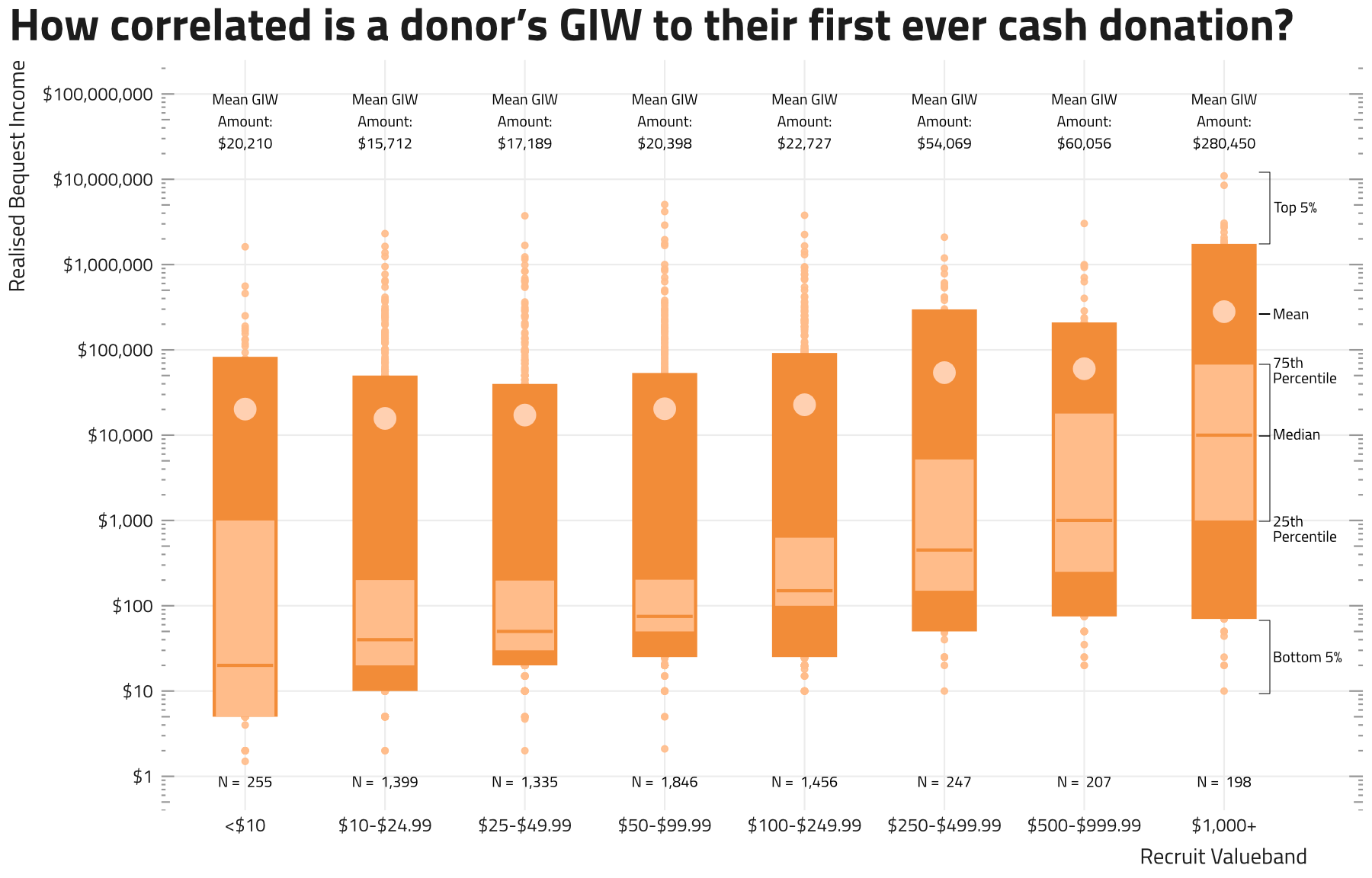
Before we committed to a large-scale investigation as part of FY27, we had a look at what we could see in our last dataset. Figure 1 shows a clear trend around the Gift-in-Will value distribution based on acquisition gift values. As part of the FY27 Fundraising Insights program, we’ll be exploring how charities can enhance their Gift-in-Will opportunities by implementing better strategies earlier in the donor life-cycle. This analysis will be valuable for fundraisers of all experiences, as it will uncover insights that haven’t been explored before in Australian & New Zealand Fundraising.
Don’t miss your opportunity to participate and gain access to this ground-breaking research.
Register or get in touch with Dan Wilson. Register for the Fundraising Insights program today.